
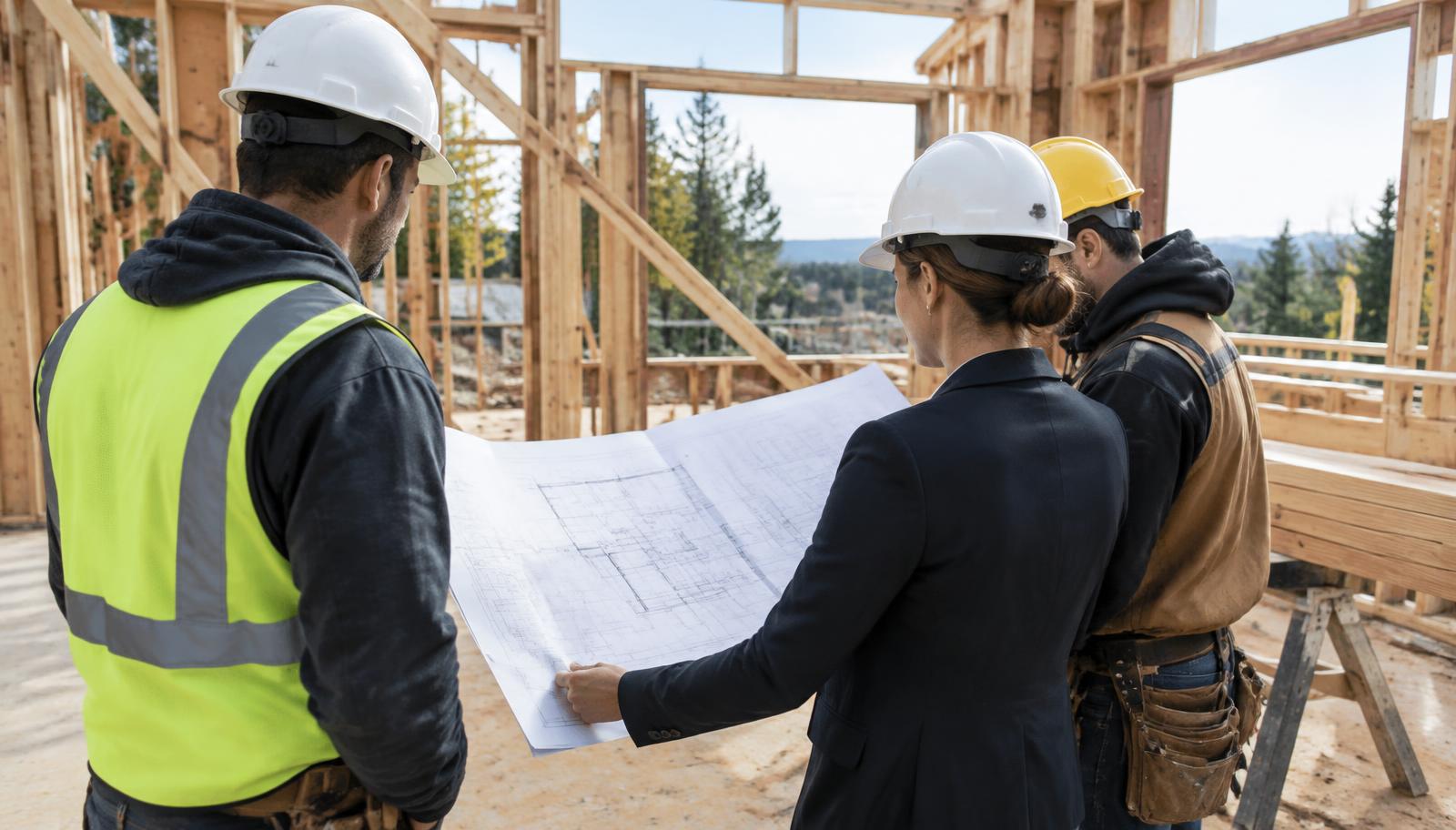
Who we help
Builders, Contractors & Design Teams
Make quality consistent from the drawings to the field.
Quality is decided twice: once in the drawings, and again by whoever is on site the day of the test. Green Summit helps homebuilders, general and specialty contractors, architects and engineers connect the two — design decisions with field results, energy models with installed systems, and rating teams in different markets with one standard of evidence. Whether you need energy-code support, construction testing, commissioning or consistency across rating teams, we define the work around your role and your project schedule.
- Licensed engineering firm
- RESNET Rating Provider No. 1998-221
- In-house CPAs
- Founded 2014
Where would you like to start?
A builder, a general contractor and an architect arrive at the same project with different questions. Choose the one closest to yours and we will show you the work that fits — and nothing else.
Solutions
Engineering & energy-code compliance
Get the sequence right and the systems follow: Manual J sizes the load, Manual S selects the equipment to meet it, and Manual D designs the ducts to deliver it — in that order, not backwards from equipment already ordered. We review energy assumptions, code-compliance paths and system interfaces alongside the architect, engineers and construction team, with energy modeling and MEP, HVAC and hot-water coordination where the project needs them. If you build in California, Title 24 has its own compliance route, and we support it.
- Energy Modeling
- Residential Energy-Code Compliance
- Commercial Energy-Code Compliance
- MEP, HVAC & Hot-Water Coordination
- Manual J Load Calculations
- Manual D Duct Design
- Manual S Equipment Selection
- California Title 24 Energy-Code Support
Field training & technical support
Give your staff and delivery partners somewhere to take the hard questions. We provide technical training and continuing education, rent and support field equipment, answer program and procedure questions as requirements change, and advise on distributed energy when a project asks your crews to install something new.
- Technical Training & Continuing Education
- Equipment Rental & Field Support
- Technical Assistance & Program Q&A
- Distributed Energy Consulting
Green building consulting
A certification is a set of responsibilities before it is a plaque. We translate the selected program — ENERGY STAR, NGBS, FGBC, Indoor AirPlus, DOE Efficient New Homes, LEED, Phius or Enterprise Green Communities — into clear responsibilities for design, construction and verification, so every trade knows what it owns and when it will be checked. Where it fits, we connect the pathway to the owner's decarbonization goals and review C-PACE financing for the projects that are eligible.
- Green Building Consulting & Certification Strategy
- ENERGY STAR Multifamily New Construction
- ENERGY STAR Homes Support
- NGBS Green Certification Support
- FGBC Green Certification Support
- Indoor AirPlus Support
- DOE Efficient New Homes Support
- LEED Consulting & Certification Support
- Phius Consulting & Passive-Building Support
- Enterprise Green Communities Consulting
- Decarbonization Consulting
- C-PACE Advisory & Financing Support
Nationwide builder & rater quality assurance
The same house should produce the same evidence in every market. We set up consistent testing, documentation, feedback and escalation practices across locations and rating teams — HERS file and field quality assurance, field inspections and ratings — so a finding in one division is caught the same way in every other. As a RESNET Rating Provider, we know where a provider's mandatory responsibilities begin, and our QA supports them without replacing them.
- Nationwide Builder & Rater Quality Assurance
- HERS File & Field Quality Assurance
- Field Inspections & Project Verification
- HERS Ratings
Project incentives & designer support
Some incentives belong to the designer, and most people on the project do not know it. On a building owned by a government, nonprofit or Tribal entity, the Section 179D deduction can be allocated to the architect, engineer or design-build contractor responsible for its energy-efficient systems — the owner decides — and because Section 179D winds down for property whose construction begins after June 30, 2026, we screen the construction-start date first. We review 179D, R&D credits, utility rebates and New Jersey's programs with the right owner, designer and tax-advisor participation; your tax advisor makes the filing decision.
- Section 179D for Designers
- Incentive & Utility Rebate Strategy
- R&D Tax-Credit Studies
- New Jersey Energy Programs & Incentive Support
- New Jersey New Construction Program Support
Testing & building systems commissioning
A failed test on closeout day is a schedule problem, not a testing problem. We plan access and test readiness with your superintendents, then verify installation and operation — blower-door, duct-leakage and commercial air-leakage testing, and functional commissioning of building systems — and document issues while there is still time to correct them. Commercial Envelope Testing Co., a wholly owned Green Summit company, performs the commercial air-leakage testing.
Our process
- Set the standard. Together we identify the required programs, the test methods that apply, the rating providers already in place and what the builder expects of every home.
- Align the teams. We set common document requirements, inspection notices, readiness checks and escalation contacts, so every location works from the same page.
- Review the field work. We coordinate the authorized inspections, tests and QA, and track every finding against the same expectations.
- Close the loop. We verify corrections and turn recurring findings into changes on the next project, not just the next punch list.
What your team gains
- More consistent evidence across communities and rating teams.
- Earlier identification of recurring field and documentation issues.
- A clear route for correction, technical support and closeout.
Why Green Summit
Green Summit is a consulting partner delivering end-to-end compliance solutions in building performance, specialty tax credits and incentives, and advisory services — a licensed engineering firm and RESNET Rating Provider with in-house CPAs, founded in 2014. For design teams, that means engineering depth: we connect energy models, load calculations and certification commitments with the actual systems and construction details. For builders, it means consistent field evidence: we coordinate documentation, rating-team feedback and corrective action across your contracted markets without replacing the mandatory responsibilities of your rating provider.
Commercial Envelope Testing Co., a wholly owned Green Summit company, provides a defined commercial testing work package alongside your project or commissioning team — a focused testing company inside a full engineering firm.
Let's talk about where consistency is breaking down.
Share your project locations, your rating arrangements and the design, testing or QA support you need.
Or call 321-273-2200 · inquiry@greensummit.com