
Our expertise · Testing, Inspection & Verification
Residential Blower-Door Testing
A measured envelope, and a record your team can still use next year.
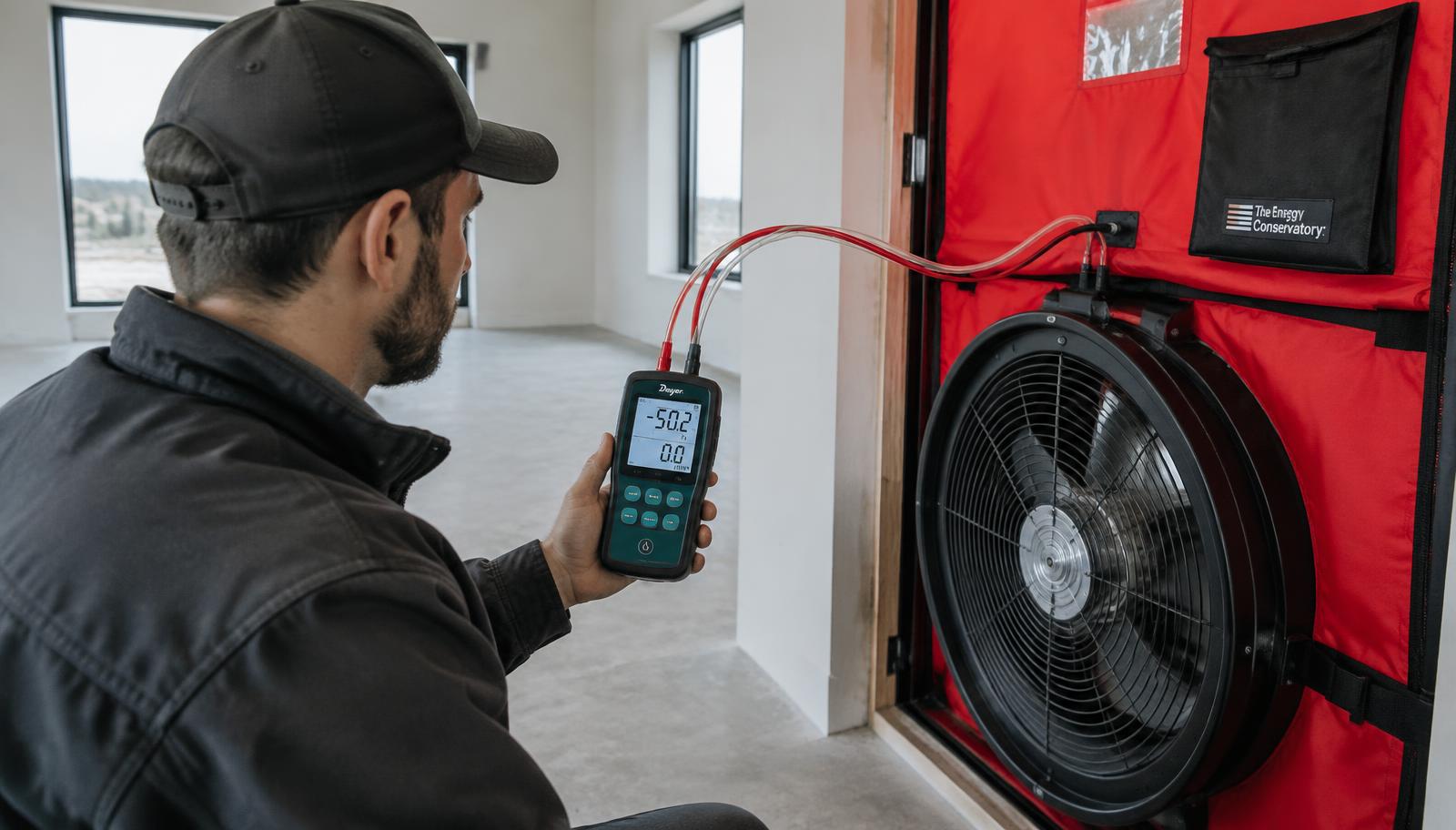
A blower door is a calibrated fan set into an exterior doorway. It holds the home at a controlled pressure difference, and the airflow needed to hold that pressure tells you how much air the enclosure leaks. The number is only useful when the test boundary is clear, the conditions suit the procedure and the record can be understood months later by someone who was not on site. Green Summit performs residential blower-door testing for energy-code, rating, certification and building-performance applications, and as a licensed engineering firm and RESNET Rating Provider (No. 1998-221) we connect each measurement with the documentation your team needs.
- Licensed engineering firm
- RESNET Rating Provider No. 1998-221
- Founded 2014
- Audit-ready documentation
Who this is for
Builders, developers, housing providers and raters who need a documented airtightness result for a home, a unit or a defined enclosure.
What we do
- Identify the purpose. We establish whether the test supports a code pathway, a rating, a certification, a program or a diagnostic review, because the purpose sets the procedure.
- Prepare the home. We coordinate access, enclosure readiness and the conditions the procedure requires, so the visit produces a valid result.
- Measure leakage. We perform the test and capture the electronic records and field information the result depends on.
- Explain next steps. We report the findings and tell you whether additional diagnostic work, corrections or retesting deserve consideration.
Our process
- Establish the requirement and the test stage. We identify what the test must satisfy and when in the schedule it should happen.
- Coordinate readiness and complete the measurement. We settle the boundary and conditions with your team, then test.
- Deliver the results and the documentation. You receive the report and the supporting records for the tested home or enclosure.
What you receive
A test report and supporting records for the defined home or enclosure. Modeling, certification and remedial work are separate services, and we include them only when your engagement calls for them.
Benefits
- A documented measure of enclosure air leakage under the specified test conditions.
- Findings that support the project's rating, compliance or diagnostic work.
- A record that reads clearly to the rater, the program reviewer or the owner who opens it later.
Why Green Summit
Green Summit is a licensed engineering firm and RESNET Rating Provider (No. 1998-221), founded in 2014 as a consulting partner delivering end-to-end compliance solutions in building performance. Our engineers, modelers and field professionals connect the analysis to installed conditions and to the decision the owner needs to make. A blower-door test can stand alone or feed a coordinated assessment, implementation and verification engagement, and either way the record is built to be audit-ready from day one.
Because the same team performs duct-leakage testing, field inspections and HERS Ratings, we place the blower-door test where it belongs in the inspection sequence rather than treating it as an isolated visit. When the test supports a rating or a program, we tell you what else that process requires and when each piece of evidence can still be gathered.
Frequently asked questions
What is a blower-door test?
A blower-door test measures the air leakage of a home's enclosure. A calibrated fan mounted in an exterior doorway holds the home at a controlled pressure difference, and the airflow required to maintain that pressure is the leakage figure. The result is compared with the criterion in the code, rating, certification or program the test supports, which is why the purpose is settled before the fan is set up.
Is a blower-door test a full energy rating?
No. A HERS Rating also requires other information, energy modeling and verification of the home. The blower-door result is one input to that process, and we tell you what else the rating needs before you assume the test completes it.
Can testing help investigate comfort problems?
It can provide useful information about the envelope. Comfort complaints often have other causes, and a broader diagnostic scope may be needed to evaluate distribution, ventilation, humidity or other conditions. We tell you when the blower door has answered its part of the question and what remains.
Should testing wait until move-in?
The right timing depends on the purpose. Early planning avoids missed inspection stages and gives the team time to address findings before closeout, when a correction is still a small job rather than a callback.
What needs to be ready before testing?
We establish the test boundary, access, temporary openings, the condition of the mechanical systems and the program procedure that applies. A readiness discussion before the visit avoids sending a technician to a building that cannot yet be tested meaningfully.
What will the report show?
The report records the building or unit, the method, the conditions, the measurements and the comparison criteria that apply. Where diagnostic follow-up or retesting is needed, we identify it separately so the record of the test itself stays clean.
Let's schedule the test at the right stage.
Tell us the home or community, its location, what the test needs to support and where the project stands today.
Related solutions
- Commercial Air-Leakage Testing
- Duct-Leakage Testing
- Field Inspections & Project Verification
- HERS Ratings
- Nationwide Builder & Rater Quality Assurance
Or call 321-273-2200 · inquiry@greensummit.com